
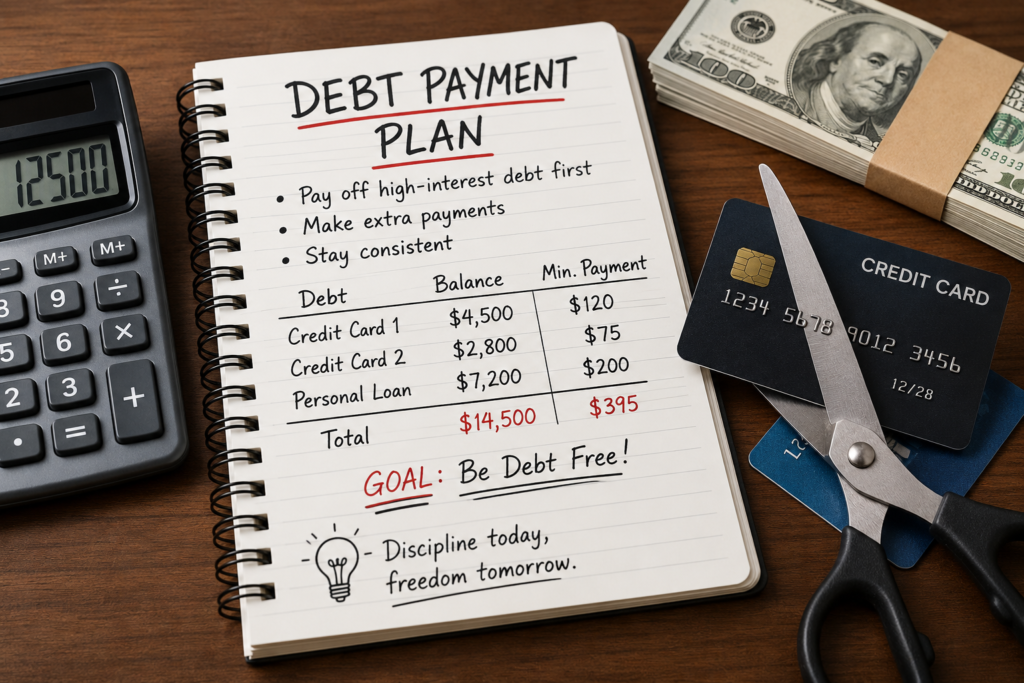
Carrying high-interest credit card debt is one of the biggest obstacles to building real wealth. With interest rates remaining elevated in 2026, keeping a balance on your cards can feel like walking on a treadmill—you are putting money toward your balance every month, but the total number barely moves.
If you are tired of throwing money away on monthly interest charges, you need a structured strategy. Paying off debt isn’t about luck; it is about choosing a mathematical system and sticking to it.
Here is a step-by-step breakdown of the two best debt payoff strategies, how to choose the right one for your personality, and how to accelerate your journey to total financial freedom.
Step 1: Stop the Bleeding and Create Your Baseline
Before choosing a payoff method, you must stop adding new charges to your accounts. Switch to using a debit card or cash for all daily purchases.
Next, list every single debt you currently owe on a piece of paper or a spreadsheet. Write down three key numbers for each account:
- The total balance owed
- The interest rate (APR)
- The minimum monthly payment
Once you have your complete list, it is time to choose your strategy.
Method 1: The Debt Snowball (Best for Fast Motivation)
Popularized by personal finance experts, the Debt Snowball method focuses on human psychology and quick wins rather than pure mathematics.
How it works:
- Rank your debts from the smallest balance to the largest balance, ignoring the interest rates.
- Pay the minimum required amount on every single debt except the smallest one.
- Throw every extra dollar you can find—from your side hustles, budget cuts, or monthly savings—at the smallest debt until it is completely paid off.
- Once the smallest balance hits $0, take the entire amount you were paying toward it and add it to the payment of the next smallest debt.
Why it works: Eliminating your first balance quickly gives you an immediate mental win. That quick victory builds momentum and keeps you motivated to tackle the larger balances.
Method 2: The Debt Avalanche (Best for Saving Money)
If you want to minimize the total amount of money you pay to the bank, the Debt Avalanche method is mathematically superior.
How it works:
- Rank your debts from the highest interest rate (APR) to the lowest interest rate, ignoring the balance size.
- Pay the minimum required amount on all your accounts.
- Direct all extra funds toward the debt with the highest interest rate.
- Once your highest-interest card is completely paid off, target the account with the next highest interest rate.
Why it works: By knocking out high-interest credit cards first, you drastically reduce the interest fees accumulating on your accounts each month, saving you hundreds or thousands of dollars in the long run.
Debt Snowball vs. Debt Avalanche: Which Should You Choose?
- Choose the Debt Snowball if you need quick visual progress to stay motivated and avoid giving up.
- Choose the Debt Avalanche if you are motivated by numbers, hate paying interest, and want the fastest mathematical route to zero.
The most important rule is simply choosing the method you can stick with until the end.
3 Ways to Accelerate Your Debt Payoff in 2026
Once you pick your strategy, use these proven tactics to speed up your progress:
- Balance Transfer Credit Cards: If your credit score is in good shape, look for a 0% APR balance transfer credit card offer. Moving high-interest debt to a 0% interest card for 12 to 18 months allows 100% of your payments to go directly toward principal.
- Use the 50/30/20 Budget: Adjust your monthly spending framework to free up extra cash. If you align your household expenses using The 50/30/20 Budget Rule, you can temporarily redirect funds from your “Wants” category directly toward your credit card balances.
- Protect Your Progress with an Emergency Cushion: The number one reason people fall back into credit card debt is unexpected household expenses (like car repairs or medical bills). Ensure you build a basic fallback fund—see our guide on How to Build an Emergency Fund in 2026—so you never have to swipe a credit card during a crisis again.
Final Thoughts
Becoming debt-free doesn’t happen overnight, but taking control of your balances is the single best financial decision you can make for your family’s future. Pick your strategy today, write down your numbers, and commit to making your first extra payment this week.